
- 1 Post
- 7 Comments
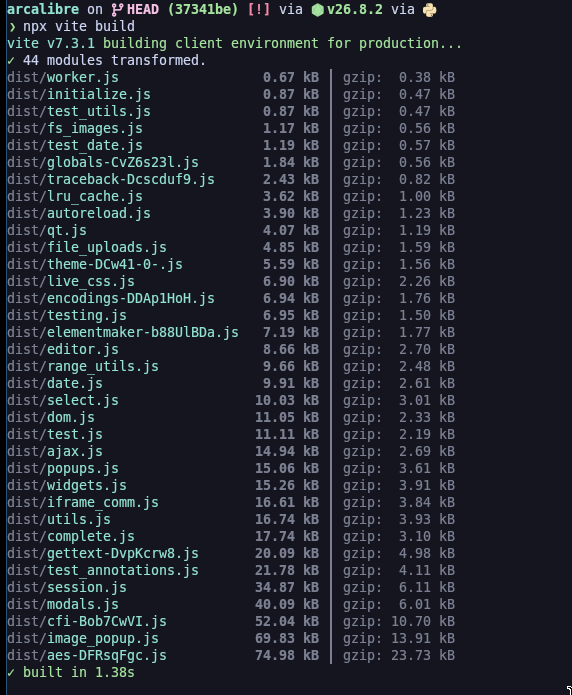
Okay, so we expected horrors and I found horrors, getting ES6 module resolution to interop with Rapydscript’s module resolution is going to be . . . for lack of a better word, “fun”.
The way the Rapydscript compiler works is to handle all module resolution at compile time, and then to produce a single Javascript file that neatly wraps up all of its inter-module resolution internally, and doesn’t even do us the favor of exposing any exports for if that file is imported elsewhere — it entirely assumes that this file will be executed in a top-level page script context, so introspecting the modules at all for testing will be a bit of an issue.
I think I can solve this by adding a new entrypoint module that uses Rapydscript’s literal inline JS syntax to specifically export the libraries I want to test:
import initialize
import utils

v'module.exports.utils = utils'
v'module.exports._modules = ρσ_modules'
and then compiling that with the
--bareoption gives a module that can at the very least be imported into a non-page context and call the functions in like a test environment.This does still present an issue that mocking out other modules for testing is going to be a mess, as they all exist on this
ρσ_modulesobject Rapydscript inserts rather than going through the normal JS module system. This also will be an issue if we start rewriting some of the modules, as we’ll need to change the way things are imported depending on if they’re in JS or RapydscriptNone of this is insurmountable, I’m going to start working on rewriting one of the smaller utility modules, and then I’ll see if I can get the module loading to work between them. (As well as start verifying whether I can modify these and see those changes in the running application)
that makes sense — once i finish up some stuff for work i’m going to do a preliminary test of what it would take to start with this (setting up typescript, maybe getting tests working with it, etc) and we can go from there
As an addendum: because this is a project that is largely Python, it also could make sense to look into Python-in-wasm tools as an alternative to Javascript/Typescript. I’m not going to make a definite suggestion here as I am not really a Python developer (nor have I used any of these) but depending on the skillsets of folks who end up involved in this, that could be a more maintainable path forward
An upside of that approach is that it might be possible to run the existing
.pyjmodules with minimal alterations, although how feasible that is / how much work it is to get the module loading to behave when used this way would depend on the Python runtime used. I’m also a bit worried that (again depending on how the runtime handles loading) this route would maybe have to be done as a much larger all-at-once change, and would have fewer opportunities to identify / test against changes introduced by the runtime’s access to web APIs differing from how Rapydscript wraps them. This would probably be a lot clearer and easier to weigh pros/cons of if someone with more Python experience wanted to try their hand at testing out the feasibility of loading a wasm runtime in the QT web context(I should say: my personal feeling is that a Python-wasm runtime is probably a more risky dependency to add than Typescript, given that the ones I’ve encountered seem relatively new, and it’s harder to know that any one we select will be maintained long-term . . . but that might be a worthwhile trade-off if having that portion of code be in Python makes it easier for folks to contribute across the project without learning another language)
Okay that makes sense. I don’t know if i want to weigh in directly on the “should we remove RapydScript” question, as that feels more like a dependent part of the broader “is the goal just an archive or adjusting for maintainability” question being sorted out elsewhere. But if the decision is made that maintainability is a project priority, then I think removing RapydScript and replacing it with something more maintainable is a pretty easy goal to get behind.
My recommendation would probably be Typescript. It is a well-supported compiler that as you mentioned would already reduce the maintenance burden a lot compared to RapydScript, and I don’t personally think the reduction in dependencies from using regular Javascript would be a good choice given how much there is to replace (at least going off the number of
.pyjfiles in the repo). The type-checking and interface definitions would be helpful for keeping that code relatively approachable, even for folks who may not have as much JS experience.As for how, I still need to poke at the Rapydscript-ng compiler a bit to sort out some of the details of how this could be implemented, but it seems like the files in the repo are already organized into isolated modules that we could potentially rewrite in Javascript or Typescript one at a time. I would suggest setting up JS unit tests based on the compiled
.pyjversions of each module, so we have a behavioral baseline to test against while doing so (and for testing any additional changes made to this code in the future). I’m not entirely sure how the modules are loaded yet but theoretically according to Rapydscript’s docs it can interop with JS just fine, so we could even merge in the rewritten modules as we go so that this doesn’t become a huge change that needs to all be resolved at once.
So as a clarification question: is QtWebEngine a runtime dependency (as in, the compiled RapydScript is executing in the web context as JS), or is it being used during the build somehow? I was operating under the assumption it was the first, but in your description of a TS/JS rewrite removing a Vulkan dependency it sounds more like the second so I want to make sure I actually understand this
I haven’t used Loomio specifically, but I am wondering if that’s not used then what is the alternative. The proposed charter seems written with the expectation that there be a formal process of some sort, so it seems helpful to lay out what the “default” process would be otherwise
I did take a look at that, I don’t think that pytest specifically is going to be that helpful for this as ideally I would like to test these modules after being compiled to Javascript — so then the same tests can be run on each as they’re replaced
With that in mind I think it might make sense to make a subdirectory inside the
tests/directory for JS tests, and then add a separate Justfile command for running jest or vitest or another Javascript test runner (I haven’t looked into what would be the best for this yet, those are just ones I have used previously)